Usage tips

Choosing Plastiline hardness:

We recommend increasing hardness depending on the size of the object, its complexity, and the fineness of the details.
As Plastiline is miscible, it is possible to use several hardness levels and colours on the same model.

Choosing Plastiline colour:

Preferably use the ivory colour (or Naples pink) when in contact with resins to avoid any potential colour migration that may occur with other colours.

Working with Plastiline:

Plastiline retains its volume, with no drying shrinkage, and no deformation is to be expected when making models. In short, it offers excellent stability. It never dries in the air: you can rework your model as many times as necessary.
Plastiline can be painted with acrylic paints and coated with a layer of shellac previously diluted in alcohol. Plastiline can be smoothed using a brush dipped in turpentine.

Plastiline can be worked:

  • As is
  • Softened
  • Liquid

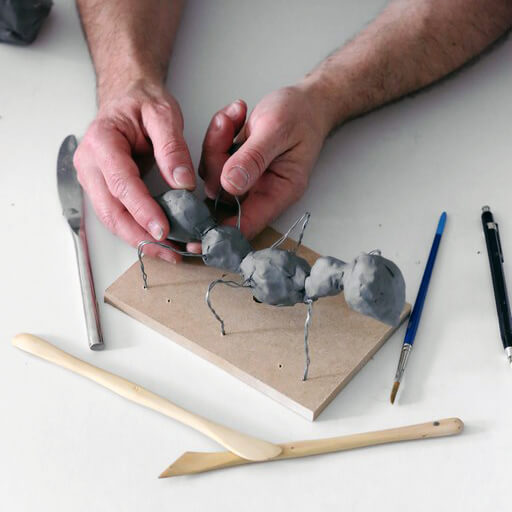
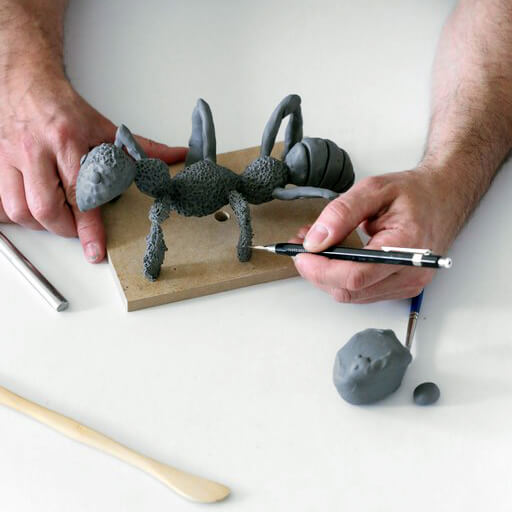
Sculpture by Laurent Mallamaci

As is:

It can be worked by hand or with tools.
Soft Plastiline is easy to work with fingers or the sculptor’s usual tools and can be used for preliminary shaping work.
Hard Plastiline requires the use of modelling tools, loop tools, and shaped knives.
Increasing hardness allows for meticulous work and detailed expression.

Softened:

Plastiline is easier to work with once softened. We recommend placing it in a bain-marie at a temperature between 30°C and 40°C. It can also be softened with a hair dryer or a heat gun.
It can also be placed in the refrigerator to harden the clay again.

Liquid:

Plastiline is liquefied in a bain-marie, in an oven, or in a container on a heat source (refer to the melting point indicated in the technical data).
When bringing it to a liquid state, it should be thoroughly homogenised to properly reincorporate the oils that rise to the surface during heating.
Stir the Plastiline using a clean instrument.
It is recommended to melt Plastiline a maximum of 5 times.